📢 This article was translated by gemini-3-flash-preview
Golang Series
Hello GoLang:
https://blog.yexca.net/en/archives/154
GoLang (var and const) Variables and Constants:
https://blog.yexca.net/en/archives/155
GoLang (func) Functions:
https://blog.yexca.net/en/archives/156
GoLang (slice and map) Slices: This article
GoLang (OOP) Object-Oriented Programming:
https://blog.yexca.net/en/archives/162
GoLang (reflect) Reflection:
https://blog.yexca.net/en/archives/204
GoLang (struct tag) Struct Tags:
https://blog.yexca.net/en/archives/205
GoLang (goroutine) Goroutines:
https://blog.yexca.net/en/archives/206
GoLang (channel) Channels:
https://blog.yexca.net/en/archives/207
Go slices are an abstraction over arrays.
Arrays
Array length is fixed.
 1
 2
 3
 4
 5
 6
 7
 8
 9
10
11
12
13
14
15
16
17
18
19
20
21
22
23
24
25
26
| package main
import "fmt"
func main() {
// Definition Method 1
var arr1 [10]int
// Iteration
for i := 0; i < len(arr1); i++ {
fmt.Println("arr1[", i, "]:", arr1[i])
}
// Definition Method 2, with assignment
arr2 := [10]int{0, 1, 2, 3}
// Iteration using range
for index, value := range arr2 {
fmt.Println("index =", index, "value =", value)
}
// Defining different lengths
var arr3 [4]int
fmt.Printf("type of arr1 is %T\n", arr1) // [10]int
fmt.Printf("type of arr1 is %T\n", arr2) // [10]int
fmt.Printf("type of arr1 is %T", arr3) // [4]int
}
|
After compiling and running, you’ll see that arr3 is a different type than arr1 and arr2. This means when defining function parameters, you must specify the exact type.
1
2
3
4
5
| func test(arr [4]int) {
for i := 0; i < len(arr); i++ {
fmt.Println("fmt_arr[", i, "]:", arr[i])
}
}
|
The function above can only accept arr3. It is pass-by-value, so modifying the data inside the function doesn’t affect the original data.
Defining Slices
Unlike arrays, slices have dynamic lengths and support appending elements (dynamic arrays). Appending may increase the slice’s capacity.
You can define a slice by declaring an array without specifying its size:
1
2
3
| var name []type
// Example
var s []int
|
Or use the make() function to create a slice:
1
2
3
| var slice []type = make([]type, len) // len is the initial length
// Or the shorthand
slice := make([]type, len)
|
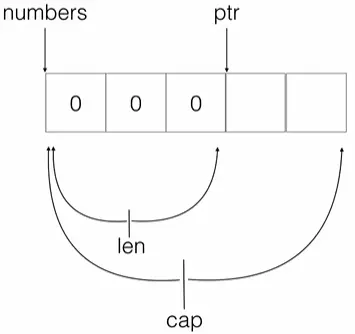
You can use the optional capacity parameter to specify capacity. If omitted, it defaults to the length.
1
| var slice []type = make([]type, length, capacity)
|
Slice Initialization
Direct initialization:
Initialize a slice from an array, from startIndex to endIndex-1. Both values are optional.
1
| s := arr[startIndex:endIndex]
|
Omitting startIndex defaults to the first element; omitting endIndex goes to the last element.
len() and cap()
Slices are indexable. Use len() to get the current length.
cap() calculates the capacity, measuring the maximum size the slice can reach.
 1
 2
 3
 4
 5
 6
 7
 8
 9
10
11
12
13
14
15
16
17
18
| package main
import "fmt"
// Slices are passed by reference; modifications inside affect original data
func printSlice(slice []int) {
fmt.Printf("len=%d, cap=%d, slice=%v", len(slice), cap(slice), slice)
}
func main() {
s := make([]int, 3, 5)
printSlice(s)
}
/*
* Output:
* len=3, cap=5, slice=[0 0 0]
*/
|
Nil Slices
An uninitialized slice defaults to nil (nil slice) with a length of 0.
 1
 2
 3
 4
 5
 6
 7
 8
 9
10
11
12
13
14
15
16
| package main
import "fmt"
func printSlice(slice []int) {
fmt.Printf("len=%d, cap=%d, slice=%v\n", len(slice), cap(slice), slice)
}
func main() {
var s []int
printSlice(s)
// Check if nil
if s == nil {
fmt.Println("slice is empty")
}
}
|
Slice Slicing
Slice a slice by setting lower and upper bounds.
 1
 2
 3
 4
 5
 6
 7
 8
 9
10
11
12
13
14
15
16
17
18
19
20
21
22
23
24
25
| package main
import "fmt"
func printSlice(slice []int) {
fmt.Printf("len=%d, cap=%d, slice=%v\n", len(slice), cap(slice), slice)
}
func main() {
s := []int{0, 1, 2, 3, 4, 5, 6, 7}
// Print original slice
fmt.Println(s)
// From index 2 (inclusive) to 5 (exclusive)
printSlice(s[2:5])
// From start to 5 (exclusive)
printSlice(s[:5])
// From index 2 to end
printSlice(s[2:])
// This assignment means modifying subS will affect s
subS := s[1:6]
printSlice(subS)
}
|
append() and copy()
Increasing slice capacity and copying slices.
 1
 2
 3
 4
 5
 6
 7
 8
 9
10
11
12
13
14
15
16
17
18
19
20
21
22
23
24
25
26
| package main
import "fmt"
func printSlice(slice []int) {
fmt.Printf("len=%d, cap=%d, slice=%v\n", len(slice), cap(slice), slice)
}
func main() {
var s []int
printSlice(s)
// Add one element
s = append(s, 0)
printSlice(s)
// Add multiple elements
s = append(s, 1, 2, 3, 4)
printSlice(s)
// Create s2 with twice the capacity of s
s2 := make([]int, len(s), cap(s)*2)
// Copy s to s2. Modifying s2 won't affect s.
copy(s2, s)
printSlice(s2)
}
|
Slice expansion: If the appended values exceed the capacity, the capacity is usually doubled.
map
There are two ways to declare a map.
 1
 2
 3
 4
 5
 6
 7
 8
 9
10
11
| package main
import "fmt"
func main() {
var map1 = make(map[string]string)
// Insert data
map1["one"] = "1"
map1["two"] = "2"
fmt.Println(map1) // map[one:1 two:2]
}
|
Method 2:
 1
 2
 3
 4
 5
 6
 7
 8
 9
10
11
| package main
import "fmt"
func main() {
map1 := map[string]string{
"one": "1",
"two": "2",
}
fmt.Println(map1)
}
|
Nested Maps
 1
 2
 3
 4
 5
 6
 7
 8
 9
10
11
12
13
14
15
16
| package main
import "fmt"
func main() {
map1 := make(map[string]map[string]string)
map1["first"] = make(map[string]string, 2)
map1["first"]["one"] = "1"
map1["first"]["two"] = "2"
fmt.Println(map1)
}
/*
* Output:
* map[first:map[one:1 two:2]]
*/
|
Update, Iterate, and Delete
 1
 2
 3
 4
 5
 6
 7
 8
 9
10
11
12
13
14
15
16
17
18
19
20
| package main
import "fmt"
func main() {
map1 := make(map[string]map[string]string)
map1["first"] = make(map[string]string, 2)
map1["first"]["one"] = "1"
map1["first"]["two"] = "2"
// Update
map1["first"]["one"] = "one"
fmt.Println(map1)
// Iterate
for key, value := range map1{
fmt.Println("key =", key, "value =", value)
}
// Delete
delete(map1, "first")
fmt.Println(map1)
}
|
Check if a key exists
 1
 2
 3
 4
 5
 6
 7
 8
 9
10
11
12
13
14
| package main
import "fmt"
func main() {
map1 := make(map[string]string)
map1["one"] = "1"
val, key := map1["one"]
if key {
fmt.Println(val)
} else {
fmt.Println("empty")
}
}
|