📢 This article was translated by gemini-3-flash-preview
Observer Pattern (Behavioral Object Pattern)
Intent
Define a one-to-many dependency between objects so that when one object changes state, all its dependents are notified and updated automatically.
Structure
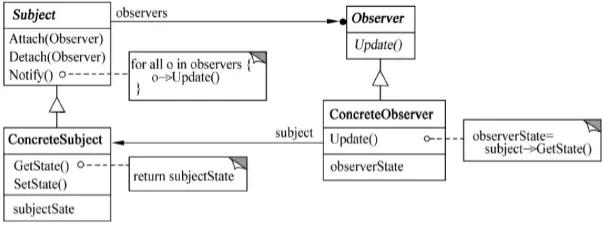
Roles:
- Subject: Knows its observers. Any number of observers can observe a single subject. It provides an interface for attaching and detaching observer objects.
- Observer: Defines an updating interface for objects that should be notified of changes in a subject.
- ConcreteSubject: Stores state of interest to ConcreteObservers. Sends a notification to its observers when its state changes.
- ConcreteObserver: Maintains a reference to a ConcreteSubject. Stores state that should stay consistent with the subject’s. Implements the Observer updating interface to keep its state consistent with the subject’s.
Applicability
Use the Observer pattern when:
- An abstraction has two aspects, one dependent on the other. Encapsulating these in separate objects lets you vary and reuse them independently.
- A change to one object requires changing others, and you don’t know how many objects need to be changed.
- An object needs to notify other objects without making assumptions about who these objects are (i.e., you want to avoid tight coupling).
Example 1
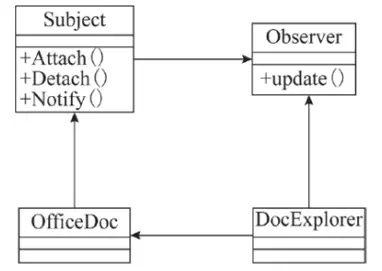
In a file management system, OfficeDoc and DocExplorer classes are defined. When an OfficeDoc object changes, all DocExplorer objects must update their state. Here is the class diagram using the Observer pattern:
 1
 2
 3
 4
 5
 6
 7
 8
 9
10
11
12
13
14
15
16
17
18
19
20
21
22
23
24
25
26
27
28
29
30
31
32
33
34
35
36
37
38
39
40
41
42
43
44
45
46
47
48
49
50
51
52
53
54
| import java.util.*;
interface Observer {
public void update();
}
interface Subject {
public void Attach(Observer obs);
public void Detach(Observer obs);
public void Notify();
public void setStatus(int status);
public int getStatus();
}
class OfficeDoc implements Subject {
private List<Observer> myObs;
private String mySubjectName;
private int m_status;
public OfficeDoc(String name) {
mySubjectName = name;
this.myObs = new ArrayList<Observer>();
m_status = 0;
}
public void Attach(Observer obs) { this.myObs.add(obs); }
public void Detach(Observer obs) { this.myObs.remove(obs); }
public void Notify() {
for (Observer obs : this.myObs) {obs.update(); }
}
public void setStatus(int status) {
m_status = status;
System.out.println("SetStatus subject[" + mySubjectName + "]status:" + status);
}
public int getStatus() { return m_status; }
}
class DocExplorer implements Observer {
private String myObsName;
public DocExplorer(String name,Subject sub) {
myObsName = name;
sub.Attach(this);
}
public void update() {
System.out.println("update observer[" + myObsName + "]");
}
}
class ObserverTest {
public static void main(String[] args) {
Subject subjectA = new OfficeDoc("subject A");
Observer observerA = new DocExplorer("observer A", subjectA);
subjectA.setStatus(1);
subjectA.Notify();
}
}
|
Example 2
Subject acts as a YouTuber, and Observer acts as a Subscriber.
 1
 2
 3
 4
 5
 6
 7
 8
 9
10
11
12
13
14
15
16
17
18
19
20
21
22
23
24
25
26
27
28
29
30
31
32
33
34
35
36
37
38
39
40
41
42
43
44
45
46
47
48
49
50
51
52
53
54
55
56
57
58
59
60
61
62
63
64
65
66
67
68
69
70
71
72
73
74
75
76
77
78
79
80
| import java.util.ArrayList;
import java.util.List;
public class ObserverPattern {
public static void main(String[] args) {
Subject subjectA = new ConcerteSubject();
Observer observer1 = new ConcerteObserver("Mike", subjectA);
Observer observer2 = new ConcerteObserver("Jane", subjectA);
subjectA.Notify();
}
}
interface Subject{ // Subject
public void Attach(Observer observer);
public void Detach(Observer observer);
public void Notify();
public String getState();
public void setState(String state);
}
class ConcerteSubject implements Subject{
private String state;
private List<Observer> observerList;
public String getState() {
return state;
}
@Override
public void setState(String state) {
this.state = state;
this.Notify();
}
public ConcerteSubject(){
state = "-1";
observerList = new ArrayList<>();
}
public void Attach(Observer observer){
observerList.add(observer);
}
public void Detach(Observer observer){
observerList.remove(observer);
}
public void Notify(){
for(Observer o : observerList){
o.update();
}
}
}
interface Observer{ // Observer
public void update();
}
class ConcerteObserver implements Observer{
private String name;
private Subject subject;
private String state;
public ConcerteObserver(String name, Subject subject){
this.name = name;
this.state = subject.getState();
this.subject = subject;
subject.Attach(this);
}
@Override
public void update(){
System.out.println(this.name + " Received");
this.state = subject.getState();
}
}
|